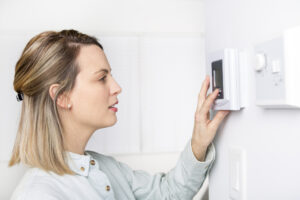
It is an all-too-familiar scenario: you come home after a long day, looking forward to the climate-controlled comfort of your living room, only to realize the air feels stagnant, chilly, or stiflingly hot. You check the display, and despite the fact that you’ve set it to your ideal temperature, the house just isn’t reaching it. While it’s easy to assume the HVAC system itself is the problem, the issue may just stem from a faulty thermostat.
Your thermostat communicates directly with your heating and cooling equipment, telling it when to turn on, how long to run, and when to shut off. It continuously monitors your home’s temperature and works to maintain your desired comfort level. However, even a small malfunction can disrupt this communication and prevent your system from working properly.
Below, we explain the most common reasons your thermostat may not be working and how you can address them.
Dead Batteries or Power Issues
One of the simplest reasons a thermostat stops working is a loss of power.
For battery-powered thermostats that are unresponsive or intermittently turning off, dead batteries are often the cause. Even if the display is still visible, low battery power can interfere with proper communication between the thermostat and your HVAC system. Replacing the batteries is a quick and inexpensive first step that can sometimes resolve the issue entirely.
For hardwired thermostats, the problem may lie with a tripped circuit breaker, a blown fuse, or an issue with the system’s power supply. Before assuming the device is broken, check your home’s electrical panel. A simple flip of a switch might be all it takes to restore communication between your thermostat and your heater or AC. If your HVAC system still isn’t receiving power, a professional inspection may be needed to safely diagnose and correct the issue.
Incorrect Thermostat Settings or Programming Errors
Sometimes, the problem isn’t mechanical at all. It’s simply a matter of incorrect settings. Thermostats, especially programmable or smart models, offer a range of features that can be confusing if not set up properly.
For example, your thermostat may be set to “cool” when you need heat, or the fan may be set to “on” instead of “auto,” causing it to run continuously without properly regulating temperature. Additionally, programmed schedules can override manual adjustments, making it seem like your system isn’t responding when it actually is following a preset routine.
If your home isn’t reaching the desired temperature, it’s worth double-checking your thermostat’s settings, schedule, and mode. Resetting the thermostat or reprogramming it according to your current needs can often restore proper operation.
Dirty or Faulty Sensors
Thermostats rely on internal sensors to accurately read the temperature in your home. If these sensors become dirty, blocked, or damaged, they may provide incorrect readings and cause your HVAC system to behave unpredictably.
Dust buildup is a common issue, especially in homes where regular HVAC maintenance hasn’t been performed. A dirty sensor may think your home is warmer or cooler than it actually is, leading to short cycling, uneven temperatures, or a system that won’t turn on at all.
Additionally, if the thermostat is located in direct sunlight, near a drafty window, or right above a heat register, the sensors will inaccurately read the real temperature of your house.
Cleaning the thermostat carefully or relocating it to a more suitable area can sometimes help, but persistent issues often require professional AC repair or replacement.
Wiring Problems or Loose Connections
Behind your thermostat is a network of wires that connect it to your HVAC system. If any of these wires become loose, damaged, or disconnected, communication between the thermostat and your equipment can break down.
Wiring issues can result from normal wear and tear, improper installation, or even pests chewing through wires. Signs of wiring problems may include an unresponsive thermostat, inconsistent system operation, or a system that won’t turn on at all.
Because thermostat wiring involves electrical components, it’s important to hire a professional. A trained HVAC technician can inspect the connections, identify any faults, and ensure everything is securely and correctly wired.
Outdated or Malfunctioning Thermostats That Need Replacement
Like any piece of technology, thermostats don’t last forever. Older models, especially manual or early digital thermostats, can become less accurate and reliable over time. If your thermostat is more than 10 years old, it may have stopped working because it’s past its prime.
Upgrading to a newer thermostat, such as a programmable or smart thermostat, can improve comfort, enhance energy efficiency, and give you greater control over your home’s climate. These modern systems also allow for remote access and customized scheduling, making them a worthwhile investment for many homeowners.
Trust the Experts for Reliable Thermostat Solutions
Thermostat issues can often be resolved quickly with the help of experienced professionals. Our technicians at H.J. Faust, Inc. know how to carefully inspect both your thermostat and HVAC system to identify the root cause of the problem. From there, we can provide reliable, long-term solutions designed to keep your system running efficiently.
If your thermostat isn’t working or is working intermittently, don’t wait for the problem to get worse. Contact our team today for expert thermostat repair, replacement, or system diagnostics. We’ll get your home back to a comfortable temperature in no time with our same-day air conditioning and heating repairs in Burlington, WI.