
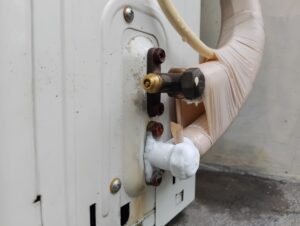
During the peak of our hot, humid summers, our air conditioning units work tirelessly to keep us cool and comfortable. But how do they do this? With the help of refrigerant! This chemical compound absorbs heat from inside your home and releases it outside. This process repeats over and over again as the hot temperatures persist. And because the refrigerant runs through a closed-loop system, it shouldn’t ever run out or need to be topped off. In fact, if your AC is low on refrigerant, there is likely a leak.
While a refrigerant leak might not sound like an emergency at first glance, it’s a serious problem with consequences for your comfort, your wallet, and even the environment. For example, ignoring a leak can lead to a cascade of issues, from poor performance and skyrocketing energy bills to catastrophic compressor failure (the compressor is the most expensive component to replace). To help you stay ahead of these potential disasters, we’ve put together a list of the top signs that your AC is leaking refrigerant so you can take action quickly.
1. Your Air Conditioner Isn’t Cooling Effectively
If your air conditioner is running constantly but struggles to reach the temperature set on your thermostat, a refrigerant leak is a prime suspect. Without the proper amount of refrigerant, the system cannot effectively absorb heat from your indoor air. The result is an AC system that blows warm or lukewarm air from the vents. You may also notice that your home feels stuffy or humid and takes much longer than usual to cool down.
2. Hissing or Gurgling Noises
Your air conditioning system should operate with a relatively consistent, low hum. So, if you hear a distinct hissing or bubbling sound, it could mean refrigerant gas is escaping from a crack in one of the lines or coils. Similarly, a gurgling noise might indicate that the system is not functioning correctly due to the low refrigerant levels. It’s important not to dismiss these sounds because they are direct indicators of an AC refrigerant leak.
3. Frozen Evaporator Coils
It might seem counterintuitive, but a lack of refrigerant can cause parts of your air conditioner to freeze up. The evaporator coil (the part inside your home) needs a specific amount of refrigerant running through it to absorb heat properly. When the level is low, the coil’s surface temperature drops below freezing. As warm, humid indoor air passes over the cold coil, the moisture in the air condenses and then freezes, quickly encasing the coil in a layer of ice.
You might see ice on the coil itself (usually located inside the indoor air handler) or notice reduced airflow from your vents because the ice is blocking the path of the air. In some cases, you might even see water leaking from your indoor unit as the ice melts when the system cycles off.
A frozen coil is a serious issue that puts immense strain on your heat pump or central air conditioner and can quickly lead to compressor damage, so please get it checked by a certified HVAC technician as soon as possible.
4. Increased Energy Bills
If your monthly electricity bills have suddenly shot up without a corresponding heatwave or change in your usage habits, you could have an AC refrigerant leak. When an air conditioner is low on refrigerant, it has to work much harder and run for longer periods to try and cool your home. This inefficiency translates directly into higher energy consumption because the system’s components, especially the compressor, are running overtime to compensate for the lack of cooling power.
5. Sudden Mechanical Failure
In the worst-case scenario, a refrigerant leak can lead to a complete system breakdown. The compressor is designed to work with a specific charge of refrigerant. When levels are low, the compressor can overheat and seize up.
Compressor failure is the most catastrophic and expensive repair an air conditioning system can have. In many cases, especially with older units, the cost of replacing a compressor is so high that it makes more sense to invest in an air conditioning replacement instead. Staying on top of a potential leak can help you avoid this costly fate.
Why a Refrigerant Leak Is Cause for Concern
AC refrigerant leaks do not simply impact your home’s comfort and your finances. A leak can have serious environmental implications. For example, if an older system that is relying on R-22 refrigerant (Freon) starts leaking, the R-22 is released into the atmosphere and contributes to the destruction of the ozone layer. Even modern systems that use newer refrigerants like R-410A, which are better for the ozone layer, can still release potent greenhouse gases that contribute to global warming.
Direct exposure to refrigerants can also be a health hazard. While a small leak in a well-ventilated area is unlikely to cause harm, inhaling refrigerant in a confined space can lead to dizziness, headaches, and even asphyxiation in severe cases. For these reasons, handling refrigerants requires specialized training and certification. We’ll say it another way: fixing refrigerant leaks is not a DIY job.
Suspect a Leak? Call the Professionals at H.J. Faust, Inc.
Do any of the signs of an AC refrigerant leak sound familiar? If so, act quickly and call H.J. Faust. Our certified and experienced technicians have the tools and expertise to diagnose the source of these leaks accurately. Once found, we can repair the leak and recharge your system to the manufacturer’s precise specifications, ensuring it runs efficiently and reliably.
Protect your investment, your comfort, and your wallet by contacting our experts today for an AC repair in Burlington, WI, or one of the neighboring areas.