When summer arrives and temperatures soar, your air conditioning system quickly becomes a vital part of your daily comfort. It allows you to escape the heat and relax. Unfortunately, even the most dependable AC systems are not immune to the effects of time and use. As the years pass, wear and tear begin to show, often resulting in frustrating breakdowns or noticeable dips in performance.
At some point, every homeowner will face the dilemma: is it better to repair the current system or invest in a full replacement? This decision is not always straightforward, and several key factors must be carefully weighed. For example, understanding the condition of your unit, its performance history, and its long-term costs can guide you toward the most beneficial outcome.
Let’s take a closer look at when to repair or replace your air conditioning system.
Factors to Consider When Choosing Between Repairing or Replacing Your AC System
Before deciding on AC repair or replacement, it’s important to conduct a comprehensive evaluation of your unit. Taking into account factors like the unit’s age, repair frequency, efficiency, and costs will offer clarity, as each of these elements can affect your comfort level, budget, and overall energy consumption.
Age of Your AC Unit
One of the primary indicators that it might be time for a replacement is the age of your air conditioning unit. Most AC systems have a life expectancy of 10 to 15 years, particularly when they are regularly maintained. If your unit is nearing or has surpassed this range, it may no longer operate efficiently or reliably.
Older systems also tend to struggle with newer energy standards and may not offer the same level of performance as modern units. Upgrading to a new model can significantly enhance your home comfort while also improving energy efficiency. For this reason, when an aging system begins to fail, replacement may be the most practical and forward-thinking choice.
Frequency of Repairs
If you find yourself repeatedly scheduling repairs or dealing with persistent issues, your AC unit might be on its last leg. These persistent problems not only disrupt your comfort but also take a toll on your wallet over time.
When repair costs begin to accumulate, it could make more financial sense to replace the system altogether. Instead of continuing to pour money into a failing unit, investing in a new air conditioner can offer peace of mind and consistent performance, especially during the peak of summer.
Energy Efficiency
The efficiency of your air conditioning system plays a major role in determining its value. Systems with a low Seasonal Energy Efficiency Ratio (SEER) are typically older models that consume more energy to provide the same level of cooling. This inefficiency results in higher monthly utility bills, which add up significantly over the course of a summer.
By upgrading to a newer, high-SEER model, you can take advantage of modern technology designed to reduce energy consumption. And investing in energy efficiency today can pay off for years to come.
Cost to Repair
When considering AC repair or replacement, it’s crucial to evaluate the cost of repairs versus the cost of a new unit. As a general rule of thumb, if the estimated cost to repair the system is more than half the price of a new unit, replacement is generally the smarter option. This guideline helps homeowners make objective decisions based on return on investment rather than quick fixes.
Beyond the immediate repair cost, you should also consider any potential future repairs. If your unit has a history of issues or requires expensive components (such as a new compressor), replacing it might be a more financially sound solution.
How Long You Will Be Staying in Your House
If you are planning to sell your house in the near future, a brand-new AC system can be a significant selling point for potential buyers. It can increase the value of your home and make it more attractive on the market. However, if you plan on moving soon, a major investment in a new system may not be the most sensible financial choice, and a less expensive repair might be more appropriate. Conversely, if you intend to stay in your home for many years, investing in a new, high-efficiency system will provide long-term comfort and energy savings.
The Type of Refrigerant Your AC Is Using
When deciding between a repair and replacement, you should consider the kind of refrigerant your air conditioner uses. Initially, older air conditioning systems used R-22 refrigerant, commonly known as Freon. Due to its harmful impact on the Earth’s ozone layer, a phase-out of R-22 began years ago. The replacement for R-22 was R-410A. While not damaging to the ozone layer, R-410A has a high Global Warming Potential (GWP), contributing to climate change. As a result, in 2025, the U.S. Environmental Protection Agency (EPA) has initiated a phase-out of R-410A as well. As of January 1, 2025, the production and import of new residential and light commercial air conditioning systems containing R-410A are no longer permitted.
While you can still use your existing R-410A system and have it serviced, the supply of R-410A will diminish over time, leading to increased service costs in the future. The new generation of air conditioners will use refrigerants with a much lower GWP and will be more energy-efficient. For this reason, investing in a new system with a next-generation refrigerant could be a more forward-thinking and sustainable choice.
The Status of Your AC’s Warranty
Most new systems come with a manufacturer’s warranty that can last from 5 to 10 years and may cover parts, labor, or both. If your AC unit is still under warranty, it is often more financially advantageous to repair it, as the costs for parts and sometimes labor will be covered.
However, if the warranty has expired, you will be responsible for the full cost of any repairs. In this case, you will need to weigh the cost of the repair against the price of a new, warrantied system.
Your Home’s Indoor Air Quality
Because an older, failing air conditioner can become a source of airborne contaminants and negatively affect your health and comfort, it sometimes makes sense to invest in an entirely new unit.
As systems age, they accumulate dust, pollen, and other debris in the internal components and ductwork. They can also struggle with humidity control, with inadequate dehumidification leading to the growth of mold and mildew. By replacing the old unit, you could dramatically improve your home’s air.
New systems offer far superior filtration, with the ability to use high-efficiency air filters (rated with a higher MERV, or Minimum Efficiency Reporting Value) that can capture much smaller particles. Modern units are also significantly better at controlling humidity, which helps prevent the conditions that allow mold and mildew to thrive. If you or your family members suffer from allergies, asthma, or other respiratory issues, the improvement in indoor air quality can be one of the most compelling reasons to invest in a new AC system.
An HVAC Technician’s Recommendation
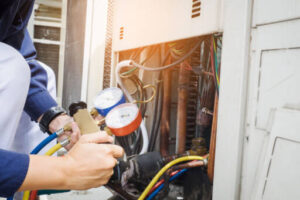
Calling in an experienced HVAC technician to inspect your air conditioning system can provide valuable insights. They can assess the overall condition of your unit and give you an expert opinion on whether it’s more cost-effective to repair or replace the AC unit.
So, Should You Repair or Replace Your Air Conditioning System?
There’s no one-size-fits-all answer when it comes to AC repair or replacement. It depends on various factors, including the age of your unit, its maintenance history, the frequency of breakdowns, energy efficiency, and the cost of repairs. Just remember that while repairs may seem like a more budget-friendly option in the short term, replacing an old, inefficient AC system can save you money in the long run.
When AC Repair Is the Best Option
- Your air conditioning unit is less than 10 years old and has been well-maintained.
- The required repair is a minor, one-time issue and is not a recurring problem.
- The cost of the repair is less than 50% of the cost of a new, comparable system.
- Your AC unit is still covered by a manufacturer’s or labor warranty, which would make the repair significantly cheaper or free.
- Your current system has a good energy efficiency rating (SEER rating) and does not contribute to excessively high utility bills.
- You are planning to move out of your home within the next year or two.
When AC Replacement Is the Best Option
- Your air conditioning system is over 15 years old and nearing the end of its typical lifespan.
- You are frequently calling for repairs, and the costs are starting to add up.
- Your current AC unit has a low SEER rating, causing your energy bills to be consistently high.
- Your system uses R-22 refrigerant, which is phased out and extremely expensive to source for repairs.
- Your system uses R-410A refrigerant, which is currently being phased out (as of 2025), making future repairs potentially more expensive.
- You want to take advantage of new technology for better energy efficiency, quieter operation, and improved home comfort.
- You plan on staying in your home for many years and want to invest in a reliable, long-term cooling solution that can also increase your home’s value.
Let’s Find the Right AC Solution for Your Home
Making the final call to repair or replace your air conditioner is a big decision, but you don’t have to make it alone. H.J. Faust, Inc. is here to provide clarity. Our experienced technicians can perform a thorough inspection to help you choose the most effective path forward, whether it’s a critical AC repair or a high-efficiency air conditioning replacement. We are committed to keeping homes in Burlington, WI, and the surrounding communities comfortable all summer. We can even help with ductless mini-split repairs and installations.
Let us help you make a smart choice. Schedule an AC inspection today!